Source: FILM OF THE WEEK: OFFICE SPACE
-
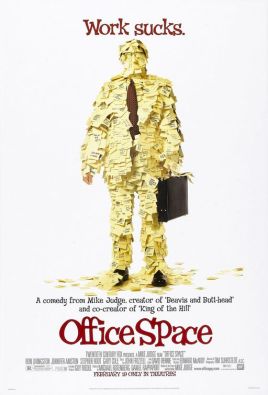
It’s funny how some films pass you by. It’s much more difficult to miss things these days with media coming at you from multiple angles. Or maybe that’s the problem.
Office Space will be familiar to a generation of meme enthusiasts, perhaps more so than the film itself. Its chief protagonist in these images is the hateful, malignant Porsche driving boss Bill Lumbergh( played by Gary Cole). A character as despicable as Willy Wonka was disinterested.
The film sees Peter, a twenty-something American male whose employment involves fixing the potential Y2K issues that might affect the accounts which are all computer based at this point. His main concerns are forgetting to put new cover sheets on his documents, wondering if his girlfriend is cheating on him and trying to pick the right lane on the freeway while commuting to work.
His colleagues, Samir and Michael Bolton(just coincidence) are slightly more technically minded on the I.T side of things, though no less alienated from society.
Trouble is brewing when a couple of guys from personnel arrive, trying to save money by firing a few heads. Everyone is on edge, except Peter, whose worries have recently disappeared since a visit to a hypnotist.
In the aftermath of the clinic visit, he suddenly becomes a self-aware, carefree soul who pays no heed to the wants and whiles of Lumbergh. Nor does he have any fear of asking the cute waitress(played here by Jennifer Aniston, how did they find the money to afford her??) out for lunch.
Of course, this production is not built on plot alone. The character driven piece is designed to get the viewers(hopefully real life slackers) to both root for and rage against familiar types they might recognise from their own cubicle partitioned gulags. It is to Gary Cole’s and to a lesser extent Steve Root’s eternal credit that they are so memorable.
The film itself is no ground breaker. It has the usual ahem…staples. Anti-social psychopathic men with soup stained shirts, easy living next-door neighbours behind paper thin suburban walls. As a critique on modern American working culture its themes are easily identifiable.
Production wise it looks and feels more like a one camera comedy you might see on Comedy Central. The colour grade is dull but yet carries the assured glean of daytime television. In a way, it’s ideal for these characters who know their limitations all too well.
The film itself ranks high in the all time Imdb lists, a cult classic that steadily become more iconic with each passing year. Directed by Mike Judge(he of Beavis and Butthead fame) it remains a fine addition to that most valued of genres, the slacker comedy.
-
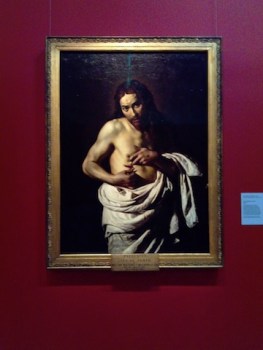
There is a lot to be said for going to an art museum. Especially on weekdays if you manage it. Unfortunately, times being as they are, there will be a strategically placed gift shop for you to negotiate. Once you have either ignored or surrendered to all those Da Vinci fridge magnet’s however, you’re into a new and magical world.
One exhibition that drew my attention recently was the Caravaggio display in National Gallery of Ireland, near Lincoln Place in Dublin. I had promised myself the past few weeks that I’d head in. So I decided to do so, albeit on the warmest day of the year thus far.
I was warned beforehand that it wouldn’t be wall to wall original work from the man himself, but rather a selection from those who studied under him from the early 17th century onwards.
The exhibit has been well promoted on the radio waves the past few weeks. There was one such documentary on Newstalk that is well worth catching up on. I learned among other things that our pal Caravaggio was a lot like our other pal Fyodor; he didn’t much like his landlords.
Moving onto the work itself. All in all, there’s about 30 pieces in the display. The artists hailed from Western Europe; France, Germany, Netherlands and of course Italy. All inspired by the style that made Caravaggio so familiar. The spotlight style, I like to call it.
From what I can discern there is a question of how he managed to attain this light. Legendary photographer David Hockney has stated he believes it was through the camera obscura, others aren’t so sure. What was clear to me in that collection was that Caravaggio definitely managed to get his models to stand for him longer than most; he was not known to use sketches as a reference.
All art is quite rightly subjective but for this scribe, you really can’t argue with realism. Detail is often derided as merely replicating what you see, that it lacks a personality all its own. What people might forget is that without Caravaggio’s innovation, this might never have become an argument.
His unique means of lighting his subjects have long since become standard, not only in fine art but also in modern film-making.
A strong, stark light casts itself on the subject, offering pin sharp detail wherever its beam lands. In turn, this can create wonderful atmosphere, depth and shadow. Unlike so much two-dimensional work that preceded him, one can only imagine the excitement of seeing such realistic depictions back then.
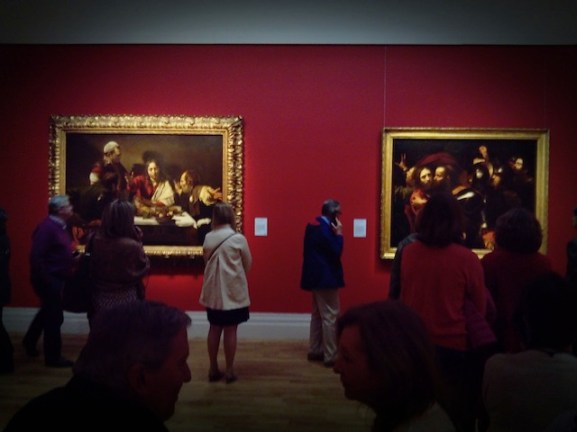
In his most famous work ‘The Taking of Christ’ the central character is brilliantly detailed. The angry tones of red warning everyone of impending doom. But what struck me with seeing both this and ‘The Supper at Emmaus’ up close was the attention paid to the co-stars(for want of a better description) This became really noticeable when compared to the other works on display.
That’s not to dismiss their paintings completely. I counted about 15 pieces that really grabbed my attention.
Out of those my favourites were
- Nicholas Tournier: Dice Players (great detail on the hands)
- Dirck van Baburen: Man with a wine flask (full of personality)
- Cecco Del Caravaggio: A Musician (beautifully rendered ruffles!)
- Orazio Gentileschi: David And Goliath (epic, just on the size of the canvas alone)
- Giovanni Antonio Galli: Christ displaying his wounds ( full of attitude)
There were recurring themes in a lot of the work. The prevailing mood of the day seemed to be quite jovial with games of Dice documented a few times. There were also two very different retellings of a scene from Sodom, which were both shocking in their origin but only one was truly graphic.
I suppose a lot of these were painted because of society’s wants at the time. There was surely commissions from the Church to depict biblical scenes but many artists seem to be cowed by this responsibility, often being too reverential to the subject matter. Not so Caravaggio and a number of these younger prodigies. I can imagine depicting Jesus Christ in such a real and vulnerable state would have raised a lot of eyebrows back then. Caravaggio certainly wasn’t the first to depict him as such, but few if any managed to deliver such moments with the fury and intensity that he did.
As a layman and a guy walking in off the street I can’t say I know much about it but I know what I like. The gallery’s crimson walls are ideal for this collection. Some of them work better than others but for those that do, you’ll be left with these images painted into your psyche for days afterwards.
-

I have no great affection for the horror genre overall. That is to say if I hear a film is good and it happens to be a horror, I’ll go and watch that bad boy. Though I wouldn’t actively seek such films out over, say a crime drama.
I often think I might be missing a trick. Historically many horror films have been very innovative. Just from a technical level, the likes of Sam Raimi (Evil Dead) and Roman Polanski (Repulsion) used camera trickery and live action effects to overcome budget constraints, both to great effect.
Unfortunately, though I think I have been desensitized to the gore by overused tropes and hammy acting. That is a sweeping statement I’m sure I’ll live to regret but I’ll digress.
…Why did I make an exception here? Well, word of mouth really.
This was selected as the secret film at the ADIFF recently and from what I could tell afterward, it really went down well with the audience that afternoon.
I overheard mention of liberal revenge and sharp irony and couldn’t resist. It’s very rare for a horror film to aim as high as wanting to make a political statement so I had to see for myself.
The film opens in a moonlit suburbia scene all too familiar to young black men. That it’s handled with such a deft touch as Peele manages here offers great hope for what’s to follow.
We are then introduced to the main players with Chris( Daniel Kaluuya) about to visit his girlfriend’s (Rose: played by Alison Williams) in-laws for the first time. The thought of that might be scary enough for some and it certainly makes Chris wonder what awaits him. By now it’s obvious that Chris is black. If you have missed the point he will remind you. His GF doesn’t think it matters but Chris remains uncertain. We also learn that he is currently trying to quit cigarettes. Concentrate, there will be a test later. Rose tries to assure him that his dad will be over friendly if anything(and that he would have voted for Obama 3 times if it were possible)
They set off on their journey in a well marked red Lincoln. Red for Danger? Lincoln for America? Or is it too paranoid to wonder these things? Already I’m on edge as I watch! When Chris’s friend (Rod: played brilliantly by LiRel Howery) calls him on the cell phone there is playful chit chat as well as mild flirting with Rose. Just as this ends, a reindeer jumps out straight in front of the vehicle. Damage is done to the car but thankfully not the passengers. A policeman arrives and can’t help but racially profile. Chris is a lot more accepting about this than the Rose. They continue their journey to the house.
I realise this is perhaps an overly descriptive account of events. And that to continue down this path would render your viewing of the film quite redundant. But I felt it important to show how normal the set-up is here.
This could easily still turn out to be a black(sic) comedy or the type of earnest Oscar bait well-meaning drama that Hollywood is convinced we all adore. All in all, it’s a gamble to play it out like this. But when you reach the end some 90 minutes later, all of these pieces of string have been neatly tidied up in a bow.
Director and writer Jordan Peele manages to gently tweak the tension slightly. We see the dad as a harmless, perhaps overtly liberal white apologist. Then the roguish son Jeremy, a kind of Heath Ledger( Monster’s Ball era), Calvin Candie hybrid who fails to hide his contempt as well as the rest of the family.
But where do I go from here in this review? Do I continue down the path of telling you the whole plot? I don’t think that would anyone any good.
Peele has created a situation that would be familiar to many living in L.A. The uneasy question of how rich white people still view black people. The question here doesn’t carry the same sledge-hammer style introspection seen in Crash( a film that decides to answer everything for you anyway, whether you like it or not) but more of the uncomfortable grey area variety.
There is one such scene that I didn’t give too much thought to. At least until I read a review after seeing it. The reviewer had expressed doubts about the relevancy of the gardener sprinting around at night time. At the time of watching I did wonder that myself. It was certainly worthy of a horror film in its framing alone. An ominous figure emerging from the shadows and hurtling towards Chris at great speed.
Then I began to think. What if this was a call back to the earlier comment from Jeremy? He had launched into a slow burning rant at the dinner table, talking about the black man being a superior athlete because of simple genetics. He had then insisted on a playful grapple with our Chris, before getting reined in by his parents.
That the son was a bigot was not in question. But there are a great many people in the world who genuinely believe that athletes of African American origin do have a genetic advantage in sports. Personally, I can’t consolidate the fact that while a white man hasn’t won the 100m at the Olympics since the 1980s, for every Usain Bolt, there’s a Daniel Sturridge just waiting to collapse in a heap. You can’t just assume a person is a superior specimen because of the colour of their skin, yet so many people do.
Point being the film is ratcheting up the tension by asking the audience these uncomfortable questions. But not dwelling on them long enough for it to become preachy. Before we know it we’re once again been creeped out by the behavior of the housekeeper, seemingly overindulged to the point that Rose’s parents can’t bring themselves to fire her.
Again, I’m trailing off slightly. I just really liked this film. For a number of reasons. Perhaps though, the most praise should fall to Catherine Keener.
I don’t think I’ve ever not enjoyed her. She’s basically acting the way Meryl Streep used to before the great Dame started getting bored. These characters she creates are so subtle, so brilliantly devised. Keener must surely study people for hours to get this kind of nuance.
But aside from that, I was thoroughly entertained for the two hours. That Hollywood is seemingly obsessed with white heroes shows an ideology at odds with the modern world. And there is little doubt that people are turning their backs on these stereotypes. Box office takings are down year on year and while television can take a fair share of responsibility, there is little doubt that the big studios are not keeping up with the times.
I think it’s pretty sad that Get Out can be seen as groundbreaking in 2017. That it has to be even seen as such. There have been hundreds of films over the last 40 odd years, which could be considered black cultural artifacts. But perhaps they too have fallen into the trap of stereotyping and small mindedness.
The great trick of this film is in its charm and ability to make some rich white folk admit they’re not cool, not ready and still want things their own way.
All that from a comedy horror? Yes, but if I try to explain anymore I’ll give away the fun bits!
-

I decided on a change of pace this month. Something true, something Irish. A story to take me back to the rare old times, when men were perennially drunk and the local lawman was uncompromising and fearless.
Lugs Branigan is an interesting character no matter what your perspective. Born in the south inner city of Dublin in 1910, he lived through the formation of the state and bore witness to the social change, both gradual and manic, until his death in 1986.
This book attempts to chart his early beginnings from within the relative comfort of his family home on the grounds of what is now St James’ Hospital right through to his final years in rural County Meath.
Of course, most people would be more interested in the space between, his forty-three years of service to An Garda Síochána.
The book is broken down into a straight chronological timeline of the early years right through to retirement. We are offered useful bits of information along the way. One important note was that Branigan hated being called Lugs. It was an allusion to his prominent ears which jutted out far beyond his head. Very few people had the nerve to call him this to his face. And those that did, we are assured, were quickly corrected.
We also learn that Branigan had early thoughts of being a vet, until family finances precluded such an arrangement. Instead he chose a career in the Irish Railway company. There he suffered badly from bullying though the writer seems unwilling to really delve into why except to say his co-workers took an immediate dislike to him. This is an early hint of what’s to come from Kearns.
We are brought along quickly as Branigan elects to take a job in the newly formed Garda Siochana. We are told how tricky it is to get a job in the service at this time, with key emphasis placed on physical size. Jim Branigan eventually becomes a sturdy seventeen stone but at this early age, he remains rakish.
After making the cut by the skin of his teeth, he begins to take a strong interest in physical fitness and among his numerous past times decides boxing is the one he likes best. This leads him to the kind of opportunities very few working class Irish people could have dreamed of back in the 1920s and 30s. A pre-WW2 trip to Germany chiefly among them.
We trudge along from there. Going from his daily beat in Dublin’s liberties and getting to know the locals to his battles with the Animal gang, a vicious mob of angry young men, employed by unscrupulous bookies amongst others. The ensuing battle at Baldoyle Racecourse, where we get to see the first signs of his maturity as a policeman come to the fore. Omnipresent throughout this are his trusty leather gloves, which according to this record at least are the only weapon Branigan ever used. The suggestion that these gloves were lined with anything foreign is quickly denounced here.
I could checklist the rest of the book and recite each chapter heading but I won’t. It’s all there, all the good stuff anyway. Marrying a fine Irish girl : check. His bodyguard duties to the likes of Cliff Richard and Liz Taylor : check. Dealing with the changing face of Irish youth from respectful, quiet Catholics to more rebellious Teddy boys and other assorted bus traveling bowsies, it’s all here.
I guess what the writer really wanted to do was to tell the story of this man’s career. What he saw and what he did to make things better. At his disposal, he has endless newspaper reports, the eyewitness accounts of younger Gardai who served with Branigan and of course the man’s family as well.
It is a very positive account of the man. Little in the way of criticism gets in the way and the reader is often subjected to repetition and bombast. Kearns is a writer I have no prior engagement with but even a cursory glance at his previous works might indicate he has something of an obsession about dreary old Dublin. It comes across here as a miserable god fearing place for the most part, with the demon drink never too far away and only one sheriff willing to clean the whole damn mess up.
For all that though, it is impossible to ignore the impact Jim Branigan had on policing Dublin city. We might only hear one side of it in this instance but there can be no doubt he was a hugely popular figure around the south inner city in particular. There are endless anecdotes about him going out of his way to protect long-suffering women from drunken spouses and more still of Branigan’s fatherly approach to would be criminals. His meticulous research before going to court and his special relationship with the judges who served there is all highlighted as well.
One advantage of Kearns stringent chronological style is that you can really imagine Dublin’s development from before the War right up until the early 1970s. Tenement houses are falling down daily as the local authority tries to keep up with the demand for new accommodation.
Unemployment is a constant as well as the trouble it brings around the city. Branigan’s attitude and response to this is largely seen as necessary action. His superior’s attitude to him is questioned later in the book, as well as the stress of poor pay and narrow scope for promotion, all of which many wouldn’t find surprising even nowadays with the Gardai.
All in all, it’s a bit one-sided but pretty informative record of the man and the service he did.
More critical accounts of his behaviour could probably be found elsewhere but this is all about a legend and the mask rarely slips.
-
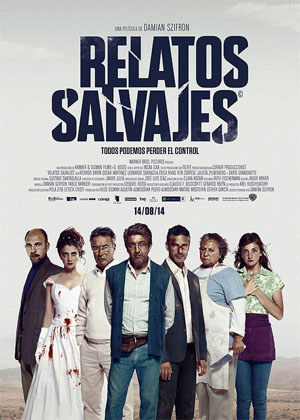
I am regularly disappointed by the output of Film Four’s TV channel. So often it just seems to be endless repeats of the X Men films and Vin Diesel led rubbish. So when something different comes along these days, it really is a pleasant surprise. Relatos Salvajes (aka Wild Tales, Argentina 2014) is just that.
The film is a collection of six short films, bearing no relation to each other, with no crossover of stories or characters. The glue binding it all together instead seems to be dark comedy and perhaps poetic justice.
The opening film is based on a large commercial flight, where a charming middle aged professor gets talking to an equally pleasant fashion model. Within minutes they’ve discovered they share a mutual acquaintance. Was it mere luck that brought them together, or kismet? It would be a shame to spoil it for you.
The other stories are also based not quite in the every day, but certainly in the bad but plausible category. There are annoying late night cafe patrons, a vehicle owner who becomes a victim of a ruthless car towing company, road rage merchants, inexperienced drivers getting bailed out by parents and a wedding with a restless bride and groom.
With Pedro Almodovar as one of the producers, there’s always a chance that domestic bliss will be challenged and that the mundane will be portrayed in epic terms, all with beautiful, crisp staging and normal people going a little bit crazy. If you’re a loyal fan of his, then you won’t go far wrong here.
But if that endorsement means nothing to you or worse yet, turns you off, it really shouldn’t. The director Damian Szifron has a long, creditable body of work in his native Argentina, many projects of which have been based in the short film format.
It really is an impressive skill to convey a story over a shortened duration. The key thing I noticed here was that while I felt the characters were important enough to care about the story, I was quite prepared to see anything happen to them, all for the benefit of the payoff. It is often a mistake I feel to put your character on some kind of impregnable pedestal.
As a writer, you are going to end up in a cul de sac of predictable behaviour, simply because you have decided that your hero needs to please everyone else. Here both Szifron and his team of writers have collectively nurtured characters who are sleazy, selfish, cowardly, stubborn, psychotic, greedy and in more than one case very much an arsehole.
In these stories too, the director doesn’t seem afraid to criticize what many people might see as perfectly reasonable. Excessive wealth is questioned but so too is extortion. Would your stereotyped beliefs allow for the fact that some men can’t change a tire properly? Or what about over exuberant wedding parties that have become new normal and that the newlyweds find comfort in the discomfort of others? it really has some good thought-provoking stuff in here.
That it is framed as well as it is, probably owes a lot to the financial backing it received. But I for one, would love to see more of this type of short film anthology style coming out of Ireland.
And the fact that it’s an international film with subtitles ought to figure positively in your decision. A good habit should be to watch something in a foreign language at least once a week. When I stick to my own rule here, I rarely regret it.
Credit to Rory Cashin on Joe.ie, .never would have heard of it but for his recommendation. Keep an eye on Film Four listings for a repeat screening.
-

Caroline, Gearoid, Paddy & Me! One of the most notable events in the Irish film calendar has become the Dublin International Film Festival. It has been around in its current guise since around the turn of the millennium. I think my first one was about ’04 or ’05. It was a more innocent time. A world without Facebook, where the Screen Cinema still looked like it would go on forever and Marvel Comics slow rise up the All Time Box Office charts was only beginning to gather pace.
I don’t recall much else from those days, except that the volunteers were always very friendly, the official Festival t-shirts were a bit cooler, the wrap party was always a good laugh and, to my regret, I never went to as many movies as I should.


This year I returned after a few years away from the madness. I was delighted to see that so many of the loyal soldiers of yesteryear were still involved in some capacity. The continuity of staff is a good thing as it always makes things easier for the newbies coming along. It certainly helped things run very smoothly as far as I could see.
As a slightly more experienced ‘volly’ you become privy to the workings of the engine room along the way. The Festival itself runs for about two to three weeks now if you include the special kiddie events and other things. But even before that, a lot of time and effort goes into making all the pieces fall into place. The marketing, the publicity, transporting the print of the film, managing the guests, hospitality, the big panic to get the red carpet done quickly and of course making sure the green room has whatever it needs, be it gummi bears or cold lagers.
The choosing of the films to be screened is decided over the course of the year. Agreements are made with distributors to offer them a place in the Festival programme, with an eye not only on quality but also variety. America, Australia, Belgium, France, Germany, Spain, Japan, Iran. Comedy, horror, animation. Oscar nominees, classics, all in.
Back in my earlier days, it might have been a bit of a struggle to see so much Irish representation but now it’s a much different story. I haven’t counted but I daresay Ireland has produced about 10-15% of 2017’s schedule…probably more actually.

This year I saw about 6 films in total. I do regret not seeing more but now that I’m living out in the boonies I guess I’m always thinking about getting back to the country air. Many of the festival staff would actually be quite jealous of my six, for it is they who suffer the most during the fortnight of screenings. It is little wonder then they find such solace in the bottom of a Five Lamps beer glass.
I really did enjoy this year, though. Perhaps even more than in previous incarnations. As a lapsed filmmaker it was nice to get out and watch a few films just for the sake of watching them, going in blind, being surprised. Always pleasantly.
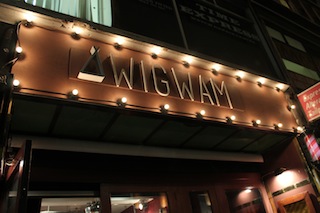
It was good to see the festival has found itself a new bar to hang out in. The means of deciding this has never been easy, with some years more successful than others. But I think Wigwam definitely compares favourably to its predecessors. Plus it was dead handy for me getting my bus home.
So there you have it. Another year, another festival in the can. If I am around Ireland again next year, I’ll certainly volunteer again, if they’ll have me. If you are living in anywhere near Dublin City or even if you aren’t but can get a bus or train into town, I highly recommend you do it.
WHAT I SAW
The Red Turtle
The Secret Garden
Girl Asleep
To Live and Die in LA
Paradise
Free Fire
WHAT I WISH I SAW
Best: All by Himself
Their Finest
Notes on Rave
Handsome Devil
& many many others
-

I don’t envy anybody who has to pick out a novel in the crime & thriller section these days. There seems to be an endless amount of options from various parts of the world and as well as a bottomless pit of writers, old and new vying for a reader’s attention.
What got me to read this? I had just finished the Ed McBain when I decided I wouldn’t mind continuing down the slang/noir route. The Guardian is fond of their ‘ten best’ lists and I saw Weirdo was the least expensive of her collection on Kindle so…
What great decisions are made by force.
Anyway, I made a start on it, not knowing what to expect really. I didn’t read up on Ms Unsworth beforehand and I’m kind of glad I didn’t. She is not a serial killer or anything. I just think that sometimes when you hear what a novelist used to do for a job it clouds how you judge their work.
Weirdo is a story based in the fictional town of Ernemouth, a sleepy seaside village in Norfolk. It follows two separate timelines chapter by chapter, with one section based in 2003/04 and the other in 1983/84. This is something I really like. Other writers have used alternative time periods to great effect. Nesbo, Faulks and of course Stephen King. It is a great way of giving even the smallest story more scope.
The noughties story sees a private detective by the name of Sean Ward arrive in the town. He has been given the job of resurrecting a cold case from the early 80s after new forensic evidence is found. Gradually he feels his way around the case by asking questions in a non-offensive way.
Ward is written in a very straightforward fashion. He is not a smart mouth nor cynical. Doesn’t go through whiskey or cigarettes like a 50s gumshoe. Respects women. In some respects, he could be considered boring but there is plenty of colour around him and I think making him so one dimensional really doesn’t do the story any harm.
The ‘Weirdo’ in question is a girl by the name of Corrine. Early in the story, we learn that she was charged with the murder of a school friend and locked up ever since, her mind long since diminished by high doses of sedatives.
That story unfolds quite neatly in the 2000s section. There are helpful journalists, overly helpful police, traumatised elderly folk with long memories, reluctant pillars of the community and Ward in the middle, trying to wrangle it all together, with only the editor of the local gazette to assist him.
What’s key all the way through the book is plot. It is by no means a masterful labyrinth of suspense but there is enough corruption, double crossing and revenge to keep those pages turning. Though the characters can be a bit clichéd at times, you really do want to get to the bottom of it all.
And how we get there is by going back. It is pretty clear reading the 80s sections, Unsworth enjoyed the trip down memory lane far more. There could even be a mixtape promotional tie-in if all the artists mentioned agreed to it. Either way, it is a simple and effective way to set mise en scene.
As the 80s story goes on we learn about Corrine, her friendships, family and future prospects. These parts are generally well written with occasional bursts of colloquialisms that don’t ever threaten to take over. The cast of characters is kept quite tight and though there are a few name and gender changes it’s not too hard to follow.
Another thread in this book is the use of voodoo. The writer does not delve too far into this which might have been a mistake. Then again she might have felt it was going to alienate her regular readers so simply decided to get the basics right and leave it at that.There is also a mention of Captain Swing which might interest some budding British historians.
The town itself, though fictional is clearly based on a composite of seasonal holiday destinations. There are the funfairs and amusement arcades that close in winter, pubs with regular low-paid punters, hair salons doing occasional business and a seemingly unspoken agreement between police and the limited criminal output to keep any aggravation to a minimum.
The writer is not one for scrupulous detail though there are some very poetic descriptions of the weather all the way through.
I found the book to be very solid all round. Unsworth works very hard to satisfy her readers by taking the plot very seriously here. It is an ideal companion for journeys on the train to and from work.
All that said, I’m not particularly loyal to any writer and I don’t know if this one convinced me to purchase any more of her titles.
-
There’s nothing I dislike more than the water cooler synopsis of a film or tv show. For one thing, it’s very hard to give a full and detailed opinion of something when you’re rushing off to do something else. The boss has his eye on you both and the doubts begin to creep in. Will I just say that yes, I really did enjoy Better Call Saul instead of engaging in a long debate about how it ran out of good ideas after the first three or four episodes*.
*note: I never even watched it, just a random example.
On the other hand, I have often flirted with the idea of being a full-time reviewer and the devastating effects it can have on you creatively. Criticism even when it’s constructive, is usually a negative thing. You are finding imperfections and if done right, taking up a lot of time to do so.
I try to avoid reviewing anything new because as I’ve found on my facebook status history, I am not the most reliable source of a review moments after watching something. I need to think about it for a while, maybe watch it twice or a third time before it all sinks in. Is this an admission that I’m a bit slow? Well, yes it is and I am!
So if you aren’t willing to critically analyse everything you see and just want to observe things and make mental notes, fair enough. But who out there, is doing this noble work instead? Well, step forward City Absurdia.
This young man has put out some excellent videos on subjects as diverse as the Easter Rising to Arnold Schwarzenegger. Critical analysis is his forte. Making an observation and explaining his reasons why is his strength. They are about eight videos available currently on Youtube( see below) and I recommend you watch any or all of them if you want to change the way you watch things or indeed just want to learn something.
https://www.youtube.com/channel/UCfMKkvxD2P65x1Wk5aVJwlg/videos
Also this week I have been watching a lot of this guy…

Bill Burr is an American comedian teetering on the edge of liberal decency every week now. He doesn’t like Hillary, feminism, snowflakes or any other of these buzzwords that have become part of the Twitter vernacular. On the flipside, he doesn’t like Trump, modern men or Steve Jobs either. I don’t know if he likes many things( the New England Patriots notwithstanding), but his annoyance at the world is quite entertaining I think.
I think he’s a bit hit and miss, overall. But he’s human, he’s not always on it, which is refreshing.
He has a few stand-up shows on Netflix but I have to say I prefer his podcasts or short bursts of him on youtube. Remember folks, it’s comedy. If you’re offended, move on!
- Bill on Steve Jobs https://www.youtube.com/watch?v=E3s-qZsjK8I
- Bill on feminism https://www.youtube.com/watch?v=N0vZhz3sN_E
3. Interview with Conan https://www.youtube.com/watch?v=Z85Tm8Py-BE&t=111s
-
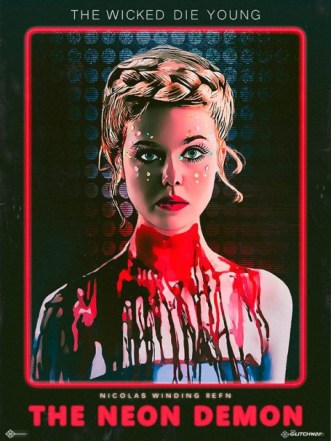
Perverted, bizarre, grotesque, pointless, self indulgent.
These are the kind of words you’ll be most likely find beside a review of this film. And with that, no doubt Nicolas Winding Refn will feel all the more validated.
When you know the rules of cinema you either spend your career strictly adhering to them or brazenly trying to ignore them. Many might think Refn is doing the latter but I’m not so sure.
Here we open with Jesse(good work here from Elle Fanning), a teenage wannabe supermodel, willing to be seen dying for her dream. Her faux blood sacrifice a mere appetiser for what’s to follow. A small town girl who has seemingly got the midnight train into L.A looking to get on the covers of some magazines. Sounds pretty traditional thus far.
She meets a make-up artist and some supermodel friends who actually turn out hating her out of fear and jealousy. But Jesse has a bit of fight in her, punchy little thing that she is.
There are cameos from such luminaries as Christine Hendricks, Keanu Reeves and the guy who played Pollax in Face Off( he also played a half decent footballer in Goal)
The plot drifts away a fair bit, hinting at the fact that Refn was particularly bored that morning he wrote the third act over his liver and kidney beans. Or perhaps it was that he realised his lead character has done little to deserve so much screen time and that he should have put more eggs in the make-up artist’s basket (Jena Malone very good here) None of this matters if you’re a fan of his oeuvre. If you are a fan, you’re wishing it was another hour long, if you’re not you probably sneaked out to watch something else.
To overanalyse any Refn film’s script is akin to creating a job for yourself where there is no market. His films have hitherto been very low on complicated narrative, lower still on creating little or any empathy for his characters( the fleeting and oftentimes humiliating career of a fashion model notwithstanding). You’d think for all that I’d hate the guy but I just don’t!
Once again the visuals are on song here. Lots of red. Lots of vacuous, classical staples of American cinema( full moon wolf symbolism, diners with simple minded waitresses, restaurants, empty swimming pools) but also nods to European horror, both literary and cinema. I can live with the deliberate lens’ flares here as I think this might a subtle metaphor for perfect imperfection…or something. But apart from that, every shot looks like something you’d hang on your wall. Admittedly, you’d have to be into some weird shit for this to happen but it’s a very weird world.
So yeah it’s gonna be adored by a few, misunderstood by many more. I wasn’t crazy about it. But I’m so glad he’s able to make stuff like this. He’s a unique talent.
 rayhyland.com